Can I Use Grab Instead of Owning a Car in Kuala Lumpur?
One of the first major headaches you'll face as an expat landing in Kuala Lumpur, after you’ve tackled immigration and found a roof over your head, is figuring out how to get around this sprawling city. The thought of navigating Malaysian traffic, dealing with parking, and understanding vehicle ownership nuances can be utterly daunting. This comprehensive guide is here to untangle that very dilemma: can you genuinely thrive in Kuala Lumpur relying solely on Grab, or is car ownership an unavoidable necessity for the expat lifestyle? We're going to break down the realities, the conveniences, the frustrations, and the cold hard cash implications so you can make an informed decision.
The Allure of Grab in Kuala Lumpur for Expats
Let's be honest, Grab is a godsend for many expats in Kuala Lumpur. When you first arrive, the idea of immediately getting a car, dealing with local registration, or even converting your driving license can feel like an administrative Everest. That's where Grab steps in, offering an immediate, seemingly effortless solution to your transport needs.
Convenience and Accessibility: A Lifeline for Newcomers
The sheer convenience of Grab cannot be overstated, especially when you're fresh off the plane and still figuring out which way is up. The app is incredibly user-friendly, universally understood, and almost entirely in English, which removes a huge language barrier. You punch in your destination, see the fare upfront, and a driver is usually there within minutes. No haggling with taxi drivers, no fumbling for cash – it's all seamless, cashless, and trackable. This is a massive relief when you’re trying to find your new apartment, navigate to immigration offices, or simply explore the city's vibrant food scene without getting lost.
Think about those initial weeks: you’re probably hopping from shopping malls like Suria KLCC to medical appointments at Pantai Hospital Kuala Lumpur, trying out local eateries, or meeting new friends in different neighbourhoods like Bangsar or Mont Kiara. Grab makes all these transitions incredibly smooth. Even after a late-night social gathering, you can rely on a Grab to get you home safely, a luxury that owning a car doesn't always afford if you plan to enjoy a drink or two. For those who are still getting their local phone plan sorted, remember that international eSIMs from providers like Airalo can be a lifesaver to ensure you always have data for your Grab bookings from day one.
Cost-Effectiveness and Predictability
Initially, many expats lean on Grab because it appears to be the more cost-effective option, and for good reason. When you factor in the myriad costs associated with car ownership in Malaysia – the hefty down payment, monthly loan instalments, compulsory car insurance, annual road tax, regular maintenance, not to mention parking fees and tolls (which are everywhere in KL!), and the ever-present cost of petrol – a few Grab rides a day can still come out cheaper for some.
Let's do a quick hypothetical. A short 15-minute ride from your condo in Subang Jaya to a meeting in Bandar Sunway might cost you between RM12-RM20 depending on traffic and demand. If you're making 2-3 such trips a day, five days a week, your monthly bill could be anywhere from RM500 to RM1000. While this might sound like a lot, compare it to the fixed and variable costs of owning a car. A new mid-range car, for example, might incur a loan repayment of RM800-RM1200, plus another RM200-RM400 for petrol, RM100 for tolls, and a monthly pro-rated amount for insurance/road tax and maintenance. For many, especially singles or couples without children living close to public transport hubs, Grab often works out to be the more financially sensible choice. The predictability of knowing the fare upfront, even with surge pricing, also helps in budgeting, unlike the surprise repair bills that come with car ownership.
Safety and Reliability for Solo Travellers and Families
For many, safety is a paramount concern, and Grab generally performs very well in this regard. The app allows you to share your journey details with friends or family, giving an added layer of security. Drivers are rated, and vehicles are typically well-maintained. This can be particularly reassuring for solo female travellers or families with young children. You know who your driver is, their car details, and the route taken, which provides a peace of mind that street taxis, in some countries, might not always offer.
There are also options like GrabCar Plus or GrabCar Premium if you're looking for a slightly more comfortable ride or simply want to avoid older vehicles. And let's not forget the "JustGrab" option, which pools different vehicle types for a faster pickup – a lifesaver when you're in a hurry. The ubiquity of Grab drivers means that even in less central areas of Kuala Lumpur, you're rarely left stranded for long, which is a significant factor in its reliability.
When Grab Falls Short: The Limitations and Frustrations
While Grab is undoubtedly a powerful tool in an expat's arsenal, painting it as a perfect, universally applicable solution would be misleading. After living here for a while, you'll inevitably encounter situations where its limitations become glaringly obvious, sometimes at the most inconvenient moments.
Peak Hours, Bad Weather, and Accessibility Challenges
The most common frustration with Grab in Kuala Lumpur is, without a doubt, surge pricing. During morning and evening rush hours, particularly between 7 AM – 9 AM and 5 PM – 7 PM, or when heavy tropical downpours hit, fares can easily double or even triple. What would normally be a RM15 ride can suddenly become RM45, and if you’re commuting daily, these surges can quickly add up, negating any perceived cost savings. Waiting times also spike during these periods, leaving you scrambling when you're already late for work or an appointment.
Moreover, if you live in an area that's a bit off the beaten path, or if you're trying to get a Grab late at night in a quiet residential neighbourhood, you might face longer waits or even struggle to find a driver at all. This can be particularly annoying if you're out past midnight in an area not known for its nightlife. For families with small children, the lack of child seats in standard Grab vehicles can also be an issue, although some services offer car seats for a premium – but these aren't always readily available. Similarly, if you have large luggage, an odd-sized purchase, or even a pet, finding a suitable Grab vehicle can be a hit or miss affair.
Beyond Kuala Lumpur: Exploring Malaysia's Wider Reaches
Kuala Lumpur might be well-served by Grab, but Malaysia is much bigger than just its capital. Venture outside the Klang Valley, even just a couple of hours away to places like Ipoh, Melaka, or the East Coast, and Grab’s ubiquity rapidly diminishes. You might find some service in major city centers, but for exploring the charming small towns, hiking trails, or pristine beaches that make Malaysia so special, a personal vehicle becomes almost essential.
Impulsive road trips to the Cameron Highlands for cooler weather, a weekend getaway to Port Dickson, or a spontaneous drive through the scenic routes of Negeri Sembilan are simply not feasible relying on Grab. You'd be looking at exorbitant intercity fares, if you can even find a driver willing to undertake such a long journey. This is where the freedom of owning your own wheels truly shines. If your expat experience in Malaysia involves more than just urban living and you dream of exploring the diverse landscapes and cultural gems scattered across the peninsula, then limiting yourself to Grab alone will prove profoundly restrictive.
Dependence on Connectivity and Device Battery
This might seem minor, but it's a genuine pain point: Grab requires a smartphone with an internet connection and a charged battery. Imagine this scenario: you're out for the day, your phone battery is critically low, and you're miles from a charging point, stuck in traffic, and suddenly you can't book a ride home. Or perhaps your mobile data plan has run out, or you're in an area with patchy network coverage. These situations are more common than you think and can quickly turn a convenient ride into a stressful ordeal.
While you can purchase local SIM cards with generous data plans easily enough, ensuring your phone is always charged is a personal responsibility that can sometimes fall by the wayside. Having a power bank is almost a necessity for a Grab-dependent lifestyle. It’s a subtle dependency, but one that can significantly impact your day when things go wrong. Choosing a reliable mobile and internet provider in Malaysia is crucial for seamless Grab use, and don't forget that if you're travelling around different states, network coverage can vary.
Hybrid Approaches and Alternative Transport Options
Living in Kuala Lumpur doesn't have to be an either/or situation when it comes to transport. Many seasoned expats find a sweet spot by combining different modes of travel, leveraging the strengths of each to suit their lifestyle and budget.
Integrating Public Transport with Grab
Kuala Lumpur has been investing heavily in its public transport infrastructure, and it's genuinely improving. The LRT, MRT, and Monorail lines now connect many key areas of the city, making commuting surprisingly efficient for certain routes. For example, if you live near an MRT station in Sungai Buloh and work in TRX, taking the train is often faster and cheaper than battling traffic.
However, public transport doesn't always offer door-to-door service. This is where Grab truly complements the system, serving as your "last mile" solution. You can take the train most of the way and then grab a ride for the final short stretch to your office or home. This hybrid approach significantly reduces your overall transport costs compared to full-time Grab use, while still offering more flexibility than public transport alone. Imagine taking the MRT to Pavilion Bukit Bintang for shopping and then simply booking a Grab to whisk you back to your condo in Sri Hartamas without worrying about walking in the heat or finding a parking spot. Check out our guide on Understanding the LRT, MRT and Monorail Systems in Kuala Lumpur for a deeper dive into how to use these networks effectively.
Short-Term Car Rental and Car Sharing
For those occasions when Grab simply won't cut it – perhaps a weekend trip to Penang, a family visit to Genting Highlands, or a day exploring the temples of Batu Caves – short-term car rental services are a fantastic option. Major international brands like Hertz and Avis operate here, as do local companies. This gives you the freedom of a personal vehicle without the long-term financial commitment and maintenance headaches.
There are also car-sharing services like GoCar and SOCAR which allow you to rent cars by the hour or day through an app, offering even greater flexibility and often more competitive rates for shorter periods. This is an excellent way to get a taste of car ownership without the full plunge, and it's perfect for those who only need a car occasionally.
The Full Car Ownership Consideration
Despite Grab's convenience, for some, owning a car in Kuala Lumpur is simply a non-negotiable. This is often the case for families with young children, especially if their international school isn't easily accessible by public transport or Grab. The convenience of packing school bags, sports equipment, and groceries into your own trunk without worrying about multiple Grab bookings or waiting times is a significant advantage.
Similarly, if your work frequently requires you to travel to industrial areas, clients outside the city center, or places with limited Grab coverage, owning a car will make your life infinitely easier and more professional. However, be prepared for the process. Getting a Malaysian driving licence, whether by conversion or application, and then purchasing, registering, and insuring a vehicle requires navigating various government departments like JPJ. For a comprehensive overview, read our guide on Driving in Malaysia: Licences, Registration and Rules for Expats (2027) and How to Buy a Car as a Foreigner in Malaysia. If you're bringing in a lot of household goods or even your own car, you might look into international moving services, and companies like Sirelo can help you find reputable movers to manage the logistics of shipping your belongings to Malaysia.
Making Your Decision: Key Factors to Consider
The choice between relying on Grab and owning a car in Kuala Lumpur isn't universal. It boils down to your personal circumstances, lifestyle, and financial priorities. Let's delve into the crucial factors that should guide your decision.
Lifestyle and Daily Commute
Your daily routine is perhaps the most critical factor.
- Where do you live? Are you in a prime, well-connected area like KLCC, Bukit Bintang, or Bangsar, where Grab drivers are plentiful and public transport options are abundant? Or have you opted for a more suburban or quieter residential area in places like Rawang or Semenyih, where Grab availability might be scarcer and waiting times longer? Expats looking for How to Find Family-Friendly Neighbourhoods in Kuala Lumpur often consider connectivity.
- Where do you work/study? Is your workplace or university located right next to an MRT or LRT station? Or is it in an industrial park or an area primarily accessible by road?
- Do you have children? Ferrying kids to school, extracurricular activities, and playdates often tips the scale towards car ownership. The sheer volume of things you need to carry for a family outing can make multiple Grab bookings impractical.
- Social life and hobbies: Do your social activities primarily involve dining out in central KL, or do you enjoy hiking in national parks, visiting out-of-town attractions, or engaging in hobbies that require transporting gear?
- Spontaneity: Do you value the freedom to spontaneously decide on a weekend getaway or a late-night drive?
Someone living in the city centre, working from home or near a major public transport hub, and rarely venturing out of Klang Valley might find Grab perfectly sufficient. A family of four living in a residential area further out, with school runs and frequent weekend excursions, would likely find car ownership indispensable.
Budgetary Realities and Hidden Costs
While we've touched on costs, it’s worth laying them out clearly. The "hidden" costs of car ownership often surprise expats. Beyond the purchase price, there are significant ongoing expenses.
Here's a simplified comparison of estimated monthly expenses:
| Expense Category | Grab-Only (Estimated Monthly) | Car Ownership (Estimated Monthly) |
|---|---|---|
| Fixed Costs | – | RM 800 – RM 1500 (Loan Repayment) |
| – | RM 80 – RM 250 (Insurance/Road Tax – Pro-rated) | |
| Variable Costs | RM 500 – RM 1500 (Grab Fares) | RM 200 – RM 500 (Petrol) |
| – | RM 50 – RM 200 (Tolls) | |
| – | RM 100 – RM 300 (Parking) | |
| Maintenance/Repairs | – | RM 100 – RM 200 (Service/Wear & Tear) |
| Total (Approx.) | RM 500 – RM 1500 | RM 1330 – RM 2950+ |
Note: These figures are approximations and can vary widely based on car model, driving habits, location, and Grab usage patterns. Car ownership costs don't include initial down payment, car accessories, or potential major repairs.
As you can see, the initial outlay for a car is substantial, and the ongoing monthly costs are significantly higher than even heavy Grab usage. This comparison also doesn't factor in the depreciation of the vehicle, which is a real cost over time. If you're keen to understand the broader financial picture, our guide on The Complete Guide to Cost of Living in Malaysia for Expats (2026) can offer more insights.
Personal Preferences and Comfort Levels
Finally, a lot comes down to personal preference. Some people simply love the freedom of driving and charting their own course. They don't want to rely on an app, worry about surge pricing, or make small talk with a driver. For them, the stress of KL traffic and finding parking is a small price to pay for autonomy.
Others prefer to outsource their driving. They enjoy being chauffeured, using travel time to catch up on emails, read, or simply relax. They find navigating traffic and finding parking to be major stressors they'd rather avoid. They are comfortable with the minor inconveniences of Grab for the greater benefit of not having to manage a vehicle.
Consider your own comfort level. Are you adaptable and patient, or do you value absolute control over your transport? Your personality will play a significant role in which option feels right for you in the long run.
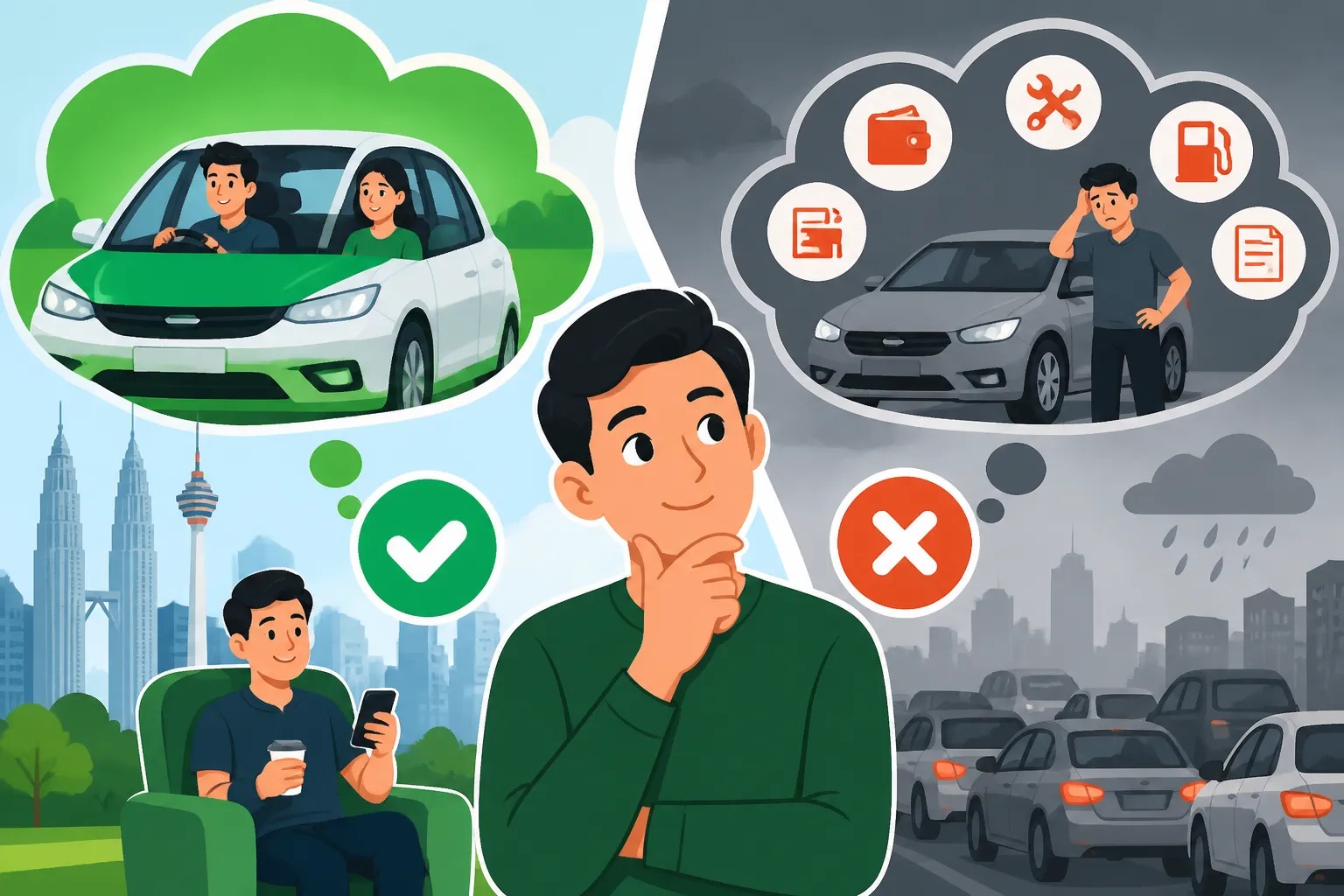
Ultimately, Kuala Lumpur offers robust options for both scenarios. You absolutely can use Grab instead of owning a car, especially if you live and work within well-connected urban areas and don't frequently travel outside the city. Many expats do it successfully. However, if your lifestyle demands more flexibility, family transport, or extensive travel across Malaysia, the convenience and autonomy of owning your own vehicle will eventually become more appealing.
Disclaimer
The information provided in this guide is for general informational purposes only and does not constitute professional advice. While we strive to provide accurate and up-to-date information, regulations, costs, and services in Malaysia can change. Always verify information with official sources or consult with relevant professionals before making any decisions.