Understanding the Sarawak and Sabah Immigration Rules for Foreigners
It's incredibly frustrating when you think you've finally wrapped your head around Malaysia's immigration rules, only to discover there's a whole other layer of complexity when it comes to Sarawak and Sabah. Many expats, myself included, have been caught off guard by the distinct regulations in East Malaysia. This guide is here to untangle those specific rules, helping you understand the unique entry, stay, and work requirements for foreigners in these two fascinating states.
The Unique Immigration Autonomy of Sarawak and Sabah
When you first land in Peninsular Malaysia, everything seems relatively straightforward regarding visas and passes. Then, the moment you mention venturing to Sarawak or Sabah, you might get a knowing look, or a quick warning about "separate immigration." It's not a myth, and it’s a crucial aspect of Malaysia’s federal system that often catches foreigners, even those living in KL for years, completely by surprise. The reality is, Sarawak and Sabah operate under their own distinct immigration ordinances, a legacy of their formation within Malaysia, and understanding this autonomy is your first step to a smooth experience.
A Historical Perspective: Why the Difference?
The unique immigration status of Sarawak and Sabah stems from the Malaysia Agreement of 1963 (MA63), which saw these two former British colonies, along with Singapore (which later left the federation), join Malaya to form Malaysia. Unlike the other states in Peninsular Malaysia, Sarawak and Sabah were granted special safeguards and autonomy, particularly over immigration matters, to protect their indigenous populations, cultures, and economic interests. This historical context is vital to grasp why these states retain powers over who can enter and reside within their borders, even if those individuals are already legally in Peninsular Malaysia. It’s not about making things difficult for you, but rather about preserving their distinct identities and ensuring that development benefits their local communities first and foremost.
These historical provisions mean that while there's a federal Malaysian Immigration Department, Sarawak and Sabah each have their own state immigration departments that wield significant authority. This dual layer of immigration control can be a source of confusion, but it's deeply rooted in the nation's founding principles. So, when you're planning a trip or a move to Kuching or Kota Kinabalu, remember you're not just entering another Malaysian state; you're entering a territory with its own distinct gatekeepers and rules. It's a bit like traveling between countries, even though it's all within one nation.
Decentralised Powers: What Does This Mean for You?
For you, the expat or aspiring resident, these decentralised powers translate into practical differences that impact everything from a casual visit to a long-term employment plan. Firstly, even if you hold a valid visa or Employment Pass for Peninsular Malaysia, it does not automatically grant you the right to enter or reside in Sarawak or Sabah. You will undergo a separate immigration check upon arrival, even on a domestic flight from Kuala Lumpur. This is why you'll often hear about expats flying from KL to Sabah needing to show their passport and immigration stamp upon arrival – it’s a very real checkpoint.
Secondly, specific permits or endorsements are often required to live and work in East Malaysia, which are issued by the respective state immigration departments. This means that an employer in Sarawak, for example, will need to apply for an Employment Pass specifically for Sarawak, under Sarawak’s rules, rather than the federal ones administered by the Expatriate Services Division (ESD) in Peninsular Malaysia. This can lead to different processing times, salary thresholds, and even eligibility criteria. It adds a layer of bureaucracy that can be perplexing, especially if you're trying to compare options across the entire country. You might find that the process for How to Get an Employment Pass in Malaysia (2026) in Kuala Lumpur is quite different from what's required for a similar role in Miri.
Navigating Entry and Short-Term Stays in East Malaysia
So, you're based in Kuala Lumpur, perhaps on a long-term social visit pass, or maybe you're just visiting Malaysia on a tourist visa. You decide to take a domestic flight to Borneo – perhaps to see the orangutans in Sarawak or climb Mount Kinabalu in Sabah. You might think, "It's a domestic flight, why would there be immigration?" But there is, and understanding this unique aspect is key to avoiding an unwelcome surprise upon arrival.
Entry from Peninsular Malaysia: The "Domestic" Immigration Check
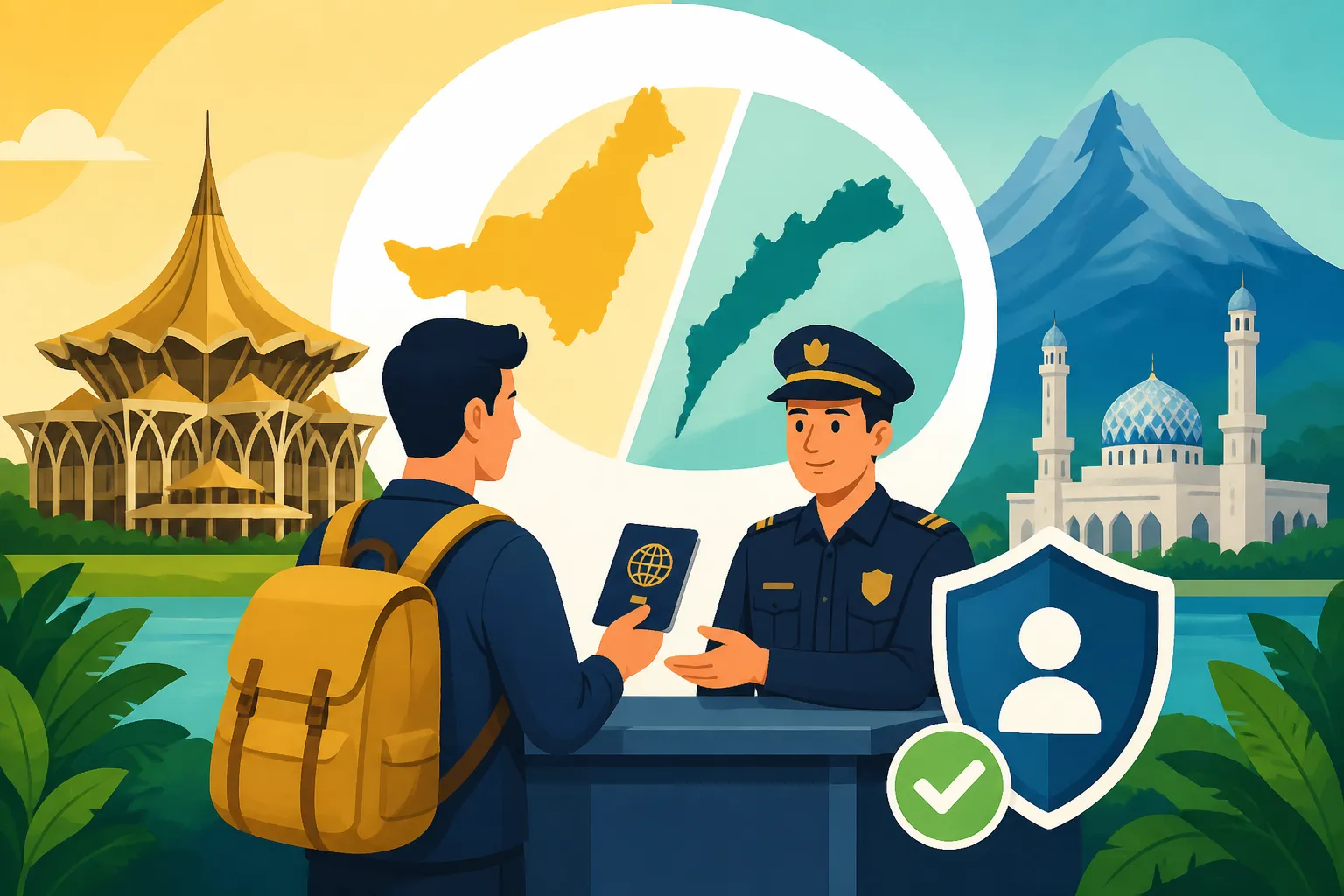
This is perhaps the most surprising aspect for many foreigners: flying from Peninsular Malaysia to Sarawak or Sabah is treated almost like an international flight in terms of immigration. When your plane lands at Kuching International Airport or Kota Kinabalu International Airport, you will be directed to an immigration counter, just as if you were arriving from overseas. You'll need to present your passport and your existing Malaysian visa or entry stamp.
The purpose of this check is for the East Malaysian states to record your entry and to ensure you are eligible to enter under their regulations. Typically, for short visits (usually up to 90 days, depending on your nationality and your existing visa status in Peninsular Malaysia), you'll be granted an entry stamp. However, this is at the discretion of the state immigration officer. It's not uncommon for officers to ask about the purpose of your visit, your duration of stay, and your onward travel plans. While most bona fide tourists or business visitors on valid passes face no issues, it's crucial to treat this as a serious immigration checkpoint. Always carry your passport, existing visa, and any relevant travel documents or return tickets.
Short-Term Visit Passes for Sarawak and Sabah
For many nationalities, especially those who enjoy visa-free entry into Peninsular Malaysia for short stays, a similar arrangement generally applies to Sarawak and Sabah. You'll typically be granted a Social Visit Pass upon arrival, allowing you to stay for a specific period, often 30 or 90 days. However, the key difference is that this pass is specific to that state. If you enter Sarawak and receive a 90-day stamp, that stamp is usually valid for Sarawak only. If you then travel to Sabah, you'll undergo another immigration check and receive a new stamp for Sabah.
It's a nuanced point, but it means that while you might think you have X number of days left in "Malaysia," your clock for Sarawak might be different from your clock for Sabah. This is particularly important for those planning extensive travel across Borneo. Always check your passport for the specific conditions of the stamp you receive. Overstaying, even by accident due to misunderstanding this state-specific allowance, can lead to serious penalties. For a more general understanding of entry, refer to The Complete Guide to Malaysian Visas for Expats (2026).
Visa-Free Entry and Social Visit Pass Nuances
For those who are granted visa-free entry into Peninsular Malaysia, the process for Sarawak and Sabah mirrors this, but with the added state-level scrutiny. For instance, citizens of many Western countries often receive a 90-day Social Visit Pass upon arrival at Kuala Lumpur International Airport. When they then fly to, say, Kota Kinabalu, they will present their passport and the officer will typically issue a new 90-day Social Visit Pass specific to Sabah.
However, there's a crucial caveat: extending these social visit passes in East Malaysia can be more challenging than in Peninsular Malaysia. The state immigration departments often have stricter policies on extensions, especially if you've already spent a significant amount of time in Malaysia. The discretion lies entirely with the state immigration authorities. If your intention is to stay longer than the initial period granted, or if you're considering a move, it's always best to clarify your options well in advance with the respective state immigration department or consider a different visa category. Understanding the Professional Visit Pass in Malaysia could be helpful if you're considering short-term work.
Employment and Work Permits: A Different Ballgame Out East
This is where the distinct immigration autonomy really comes into play and can be a source of significant challenges for foreign talent. Securing an Employment Pass in Peninsular Malaysia is already a multi-step process, but when you look to Sarawak or Sabah, you'll find that many of the rules, thresholds, and even the application processes diverge considerably. Forget what you know about the Expatriate Services Division (ESD) entirely; here, it’s all about the state immigration departments and their own unique set of requirements.
Specific Requirements for East Malaysian Employment Passes
Unlike Peninsular Malaysia where the ESD handles most Employment Pass applications, Sarawak and Sabah each have their own state immigration offices that manage these processes. This means that if you're offered a job in Kuching, your employer will apply for a Sarawak Employment Pass, and if it's in Kota Kinabalu, it'll be a Sabah Employment Pass. The requirements can differ significantly, including:
- Salary Thresholds: The minimum salary required for an expat Employment Pass may vary from those set federally. These thresholds are often designed to ensure that foreign workers are genuinely filling high-skilled positions that cannot be filled locally.
- Quotas and Localisation Policies: Both Sarawak and Sabah are generally more stringent about ensuring that jobs are first offered to local talent. This often means companies need to prove extensively that no qualified Malaysian citizen from that state can fill the role before a foreigner is considered.
- Documentation: While many core documents might be similar, there can be state-specific forms, letters, or approvals required from local ministries or boards. For example, in Sabah, certain sectors might have additional approvals from the Sabah Ministry of Resource Development and Information Technology.
This level of detail means that simply reading about How to Apply for an Employment Pass (EP) in Malaysia for Kuala Lumpur won't fully prepare you for the East Malaysian experience. Your prospective employer will need to be well-versed in the specific state immigration laws.
Prioritising Local Talent: The Impact on Foreign Workers
The overarching policy in both Sarawak and Sabah is to prioritise the employment of their own citizens. This isn't just a guideline; it's a strongly enforced principle, reflecting the spirit of MA63 to protect local interests and foster local economic development. For foreign workers, this often translates into a more rigorous application process, where the employer must provide compelling justification for hiring an expat.
For instance, a company might need to advertise the position locally for a prescribed period, interview local candidates, and then submit a detailed report to the state immigration department explaining why local candidates were unsuitable. This can significantly prolong the application timeline and increase the burden on employers. It also means that roles that might be relatively easy for an expat to secure in Peninsular Malaysia – say, in certain service sectors – could be much harder to obtain approval for in Sarawak or Sabah. This policy also influences renewals, as companies are often encouraged to train local successors over time. If you're planning a move, it's wise to engage with a reputable moving company like Sirelo to help with the logistics once your pass is secured, but remember, the pass itself is the critical first hurdle.
The Intricacies of Renewals and Transfers Between States
Renewing an Employment Pass in Sarawak or Sabah also falls under the purview of the respective state immigration department. The renewal process often involves similar scrutiny to the initial application, with a strong emphasis on continued justification for foreign employment. Companies must demonstrate that the expat's role is still essential and that efforts to localise the position are ongoing. It's not always a simple rubber-stamp exercise, and sometimes approvals might be for shorter durations than in Peninsular Malaysia. Refer to How to Renew Your Employment Pass in Malaysia for a general idea, but bear in mind the state-specific differences.
Furthermore, transferring an Employment Pass between Peninsular Malaysia and East Malaysia (or vice versa), or even between Sarawak and Sabah, is generally not straightforward. An Employment Pass issued for Kuala Lumpur is not valid for Kuching. You would typically need to cancel your existing pass and apply for an entirely new one in the target state, undergoing the full application process again. This means navigating two separate sets of bureaucracies, which can be time-consuming and require meticulous planning. It highlights the importance of truly understanding Understanding How to Move to Malaysia Legally from Abroad (2026) and where you intend to base yourself from the outset.
Long-Term Residence and Retirement in Sarawak and Sabah
For those looking beyond employment or short visits, and dreaming of a longer-term stay or retirement in the serene landscapes of East Malaysia, there are also distinct programmes and considerations. The popular Malaysia My Second Home (MM2H) programme, for example, has its own East Malaysian variants, and other long-term passes also come with state-specific conditions.
MM2H Programmes: East Malaysia's Distinct Offerings
While Peninsular Malaysia has the federal MM2H programme, both Sarawak and Sabah have introduced their own versions: Sarawak MM2H (S-MM2H) and Sabah MM2H (SB-MM2H). These state-specific programmes were created to attract retirees and long-term residents, but they come with their own unique sets of criteria, often tailored to the local economic and social landscape.
For example, S-MM2H typically has lower financial requirements (fixed deposit, offshore income, liquid assets) compared to the federal MM2H. It also often has a lower minimum age requirement for applicants. Similarly, SB-MM2H might offer different incentives or have particular requirements regarding stay duration or local investment. These differences are a direct result of the states' immigration autonomy and their efforts to promote their unique tourism and residency appeals. If you're exploring the federal programme, you might want to look at The Expat Guide to Malaysia My Second Home (MM2H) (2026), but remember to seek information specifically for the Sarawak or Sabah versions if those are your target states.
The benefit of these state-specific programmes is that they can sometimes be more accessible or offer different perks depending on your circumstances. However, they also mean that an S-MM2H visa holder, for instance, might have more limited rights to reside or establish themselves in Peninsular Malaysia without additional applications, reinforcing the "border within a border" concept.
Other Pathways to Long-Term Stay for Foreigners
Beyond MM2H, other long-term stay options like the Long-Term Social Visit Pass for spouses of Malaysian citizens or dependants of Employment Pass holders also come under state immigration jurisdiction in Sarawak and Sabah. While the fundamental principles might be similar to Peninsular Malaysia, the processing, required documents, and even the willingness to grant extensions can differ.
For instance, if you are a foreign spouse of a Malaysian citizen who is a native of Sarawak, you would typically apply for your Long-Term Social Visit Pass through the Sarawak Immigration Department, not the federal one. This again means adhering to Sarawak's specific rules and processing times. The same applies if you are a dependant of an Employment Pass holder – your Dependant Pass would be tied to the state where the main Employment Pass was issued. For more on family passes, check out How to Get a Dependant Pass for Your Spouse and Children in Malaysia, but always confirm the state-specific implications.
Property Ownership and Investment Considerations
While immigration is distinct, property ownership rules for foreigners in Sarawak and Sabah generally fall under state land laws, which can also vary. Both states have minimum price thresholds for foreign property acquisition, similar to Peninsular Malaysia, but these can be different from state to state. For example, the minimum purchase price for foreigners in Sabah might be different from that in Kuala Lumpur.
Crucially, obtaining an MM2H visa for Sarawak or Sabah does not automatically grant you unfettered rights to purchase property without complying with the state's existing land laws. Foreign property ownership rules and the processes involved in Sarawak and Sabah should be thoroughly researched with local legal counsel specializing in property law. Always remember that any investment or property decision should be made with a full understanding of both the federal and relevant state regulations. This includes understanding potential restrictions on certain types of land or properties, especially those designated for native interests.
Essential Tips for a Smooth Immigration Journey in East Malaysia
Navigating the distinct immigration rules of Sarawak and Sabah can feel like deciphering a cryptic puzzle, even for seasoned expats. But with a bit of foresight and preparation, you can streamline the process and minimise potential headaches. From carrying the right documents to knowing when to call in the professionals, these practical tips are borne from years of expat experience in Malaysia.
Documents You MUST Carry at All Times
This cannot be stressed enough: always carry your original passport with your valid visa or entry stamp when travelling to or within Sarawak and Sabah. While digital copies are handy, immigration officials will almost always require the physical document. For domestic flights from Peninsular Malaysia, your boarding pass might be sufficient to get through security, but the moment you land in Kuching or Kota Kinabalu, expect to present your passport at the immigration counter.
Beyond your passport, it's wise to carry:
- Originals or certified copies of your visa/pass: Whether it's an Employment Pass, Dependant Pass, or Long-Term Social Visit Pass, have the original endorsement page readily available.
- Proof of onward travel: Especially for short-term visitors, a return or onward flight ticket can help confirm your intentions and duration of stay.
- Proof of accommodation: A hotel booking or a letter from your host can also be helpful.
- Sufficient funds: While not always asked for, proof of financial capability can sometimes be requested, especially if there's any doubt about your ability to support yourself during your stay.
Having these documents neatly organised and easily accessible will prevent unnecessary delays and stress at immigration checkpoints. Think of every internal flight as an international border crossing, and you'll be well-prepared.
Overcoming Common Hurdles and Bureaucracy
The biggest hurdle for many is the sheer lack of consolidated information. What’s clear for Peninsular Malaysia through the ESD might be completely different, or even unwritten, for Sarawak or Sabah. Patience is a virtue, and a friendly, respectful approach goes a long way with immigration officers. They are simply enforcing state-specific laws.
- Be prepared for questions: Expect to be asked about your purpose of visit, your employer (if applicable), where you'll be staying, and your duration. Answer truthfully and clearly.
- Double-check everything: Always confirm requirements with the specific state immigration department you're dealing with, as information can change and differ from federal guidelines. Websites like the Sarawak Immigration Department or Sabah Immigration Department are your primary resources.
- Allow ample time: Processing times for employment passes or MM2H applications in East Malaysia can be lengthy due to additional vetting and localisation policies. Don't make concrete plans until you have your approved pass in hand.
- Understand the "domestic border": Remember that your Peninsular Malaysia pass is not a free pass into East Malaysia. This fundamental understanding will shape your approach to travel and long-term planning.
When to Seek Professional Guidance
Given the distinct and sometimes complex nature of Sarawak and Sabah immigration laws, there are times when professional guidance is not just helpful but essential. This is particularly true for:
- Employment Pass applications: If your employer is new to hiring foreigners in East Malaysia, or if your case is unique, an immigration consultant specializing in Sarawak or Sabah rules can be invaluable. They understand the nuances of local labour market tests and documentation.
- Long-term residency programmes: For S-MM2H or SB-MM2H, an agent who specialises in these state-specific programmes can navigate the application process more efficiently, ensuring all requirements are met.
- Complex family visas or extensions: If you're trying to extend a long-term social visit pass, especially for a spouse or parent, and face difficulties, a legal professional can advise on the best course of action.
- Business setup: If you plan to set up a business and bring in foreign talent, engaging a local legal firm or consultant familiar with both company registration and immigration laws in the target state is highly recommended.
While it might seem like an added expense, the peace of mind and the time saved by having an expert guide you through the intricate processes of the respective state immigration departments can be well worth it. Additionally, securing appropriate health insurance like Cigna Global is always a wise decision, irrespective of where you plan to reside in Malaysia, as healthcare access is a universal need for expats.
| Feature | Peninsular Malaysia (Federal) | Sarawak / Sabah (State Autonomy) |
|---|---|---|
| Immigration Authority | Malaysian Immigration Department (e.g., ESD) | Sarawak Immigration Department / Sabah Immigration Department |
| Entry from Peninsular | No immigration check | Mandatory immigration check, passport & visa required |
| Visa/Pass Validity | Federal visas/passes valid across all states | Federal visas/passes do not automatically grant entry/residency; state-specific approval needed |
| Employment Pass | Issued by Federal Immigration (e.g., ESD) | Issued by respective State Immigration, with distinct requirements |
| MM2H Programme | Federal MM2H (Ministry of Tourism, Arts & Culture) | Separate S-MM2H / SB-MM2H programmes with different criteria |
| Localisation Policy | Present, but generally less stringent for high-skilled roles | More pronounced, strong emphasis on local talent prioritisation |
| Long-Term Social Visit | Federal guidelines apply | State-specific discretion and requirements for applications/extensions |
| Extension of Stays | Generally more flexible, standard federal process | Often stricter, state-specific conditions and approval process |
Disclaimer
The information provided in this guide is for general informational purposes only and does not constitute legal or immigration advice. Immigration laws and policies in Malaysia, including those specific to Sarawak and Sabah, are subject to change without prior notice. While every effort has been made to ensure accuracy, readers are strongly advised to consult the official Malaysian Immigration Department, the Sarawak Immigration Department, the Sabah Immigration Department, or a qualified immigration consultant or legal professional for the most current and specific advice pertaining to their individual circumstances. The author and publisher will not be held responsible for any errors or omissions, or for any actions taken based on the information provided herein.