How to Access Care at a Private Hospital Group Like Pantai or Gleneagles
Walking into a glitzy lobby that looks more like a five-star hotel than a medical facility can be intimidating for any expat in Malaysia. Between the administrative nuances and the complex billing structures, getting medical attention at top-tier groups like Pantai or Gleneagles feels like a maze. This guide breaks down the entire process, from registration to discharge, so you can navigate the system with confidence.
Understanding the Private Hospital Landscape in Malaysia
The private healthcare sector in Malaysia is world-class, but it functions very differently from the public system. When you look at groups like Pantai or Gleneagles, you are dealing with hospitals under the IHH Healthcare umbrella. These are premium facilities where the staff is almost entirely English-speaking, and the technology is cutting-edge. However, the experience can vary significantly depending on whether you are walking into a facility in the heart of Kuala Lumpur or a regional branch in a smaller city.
The Major Groups: Pantai, Gleneagles, and IHH Healthcare
Pantai and Gleneagles are the two most recognizable names in Malaysian private healthcare. While they are owned by the same parent company, they often cater to slightly different demographics. Gleneagles is frequently viewed as the "luxury" tier, often located in upscale areas like Ampang or Penang's Gurney Drive. Pantai hospitals are generally more widespread, offering a similar level of high-end care but with a slightly more community-focused feel. Knowing which one is closer to your residence is the first step in Navigating the Malaysian Healthcare System: An Expat's Roadmap (2027).
Besides these two, you will also encounter other major groups like KPJ Healthcare, Sunway Medical Centre, and Subang Jaya Medical Centre (SJMC). Each has its own ecosystem of specialists. The key thing for you to remember is that these hospitals operate on a "doctor-led" model. This means that while the hospital provides the equipment and the nurses, the specialists often operate as independent consultants. This structure affects everything from how you book an appointment to how you are billed at the end of your visit.
What Sets These Groups Apart from Public Facilities
The most immediate difference you will notice is the speed of service. In a government hospital, you might wait hours for a simple consultation, whereas private hospitals are designed for efficiency. However, this efficiency comes at a premium price. You aren't just paying for the medical expertise; you are paying for the convenience, the private rooms, and the lack of bureaucratic hurdles found in the public sector. For a deeper dive into these differences, you might want to read about Public vs Private Healthcare in Malaysia: Which Should Expats Choose?.
Another significant difference is the level of personalized care. In a private hospital group, you have the luxury of choosing your own doctor. You can research their credentials, see where they were trained (many are UK or US-educated), and stick with the same physician for years. This continuity of care is often missing in the public system, where you generally see whichever medical officer is on duty. If you are a digital nomad or an expat between jobs, having a flexible plan like SafetyWing can be a lifesaver here, as it provides coverage for these private visits without the long-term commitment of a local policy.
Identifying the Nearest Hospital to Your Location
Before you actually need medical help, I highly recommend doing a "dry run" or at least a location check. If you live in Bangsar or Damansara, Pantai Hospital Kuala Lumpur will likely be your go-to. If you are closer to the embassy row or KLCC, Gleneagles Kuala Lumpur is the obvious choice. In Penang, Gleneagles is a landmark on the coast. Knowing the physical layout and the parking situation (which can be a nightmare at Pantai KL) will save you immense stress during an actual medical event.
Take note of the specialized centers within these hospitals. Some branches of Pantai are better known for oncology, while certain Gleneagles branches excel in cardiac care. You can usually find this information on their respective websites, which are quite user-friendly. Being aware of these specialties is a core part of The Expat Guide to Choosing a Private Hospital in Malaysia (2027). Don't just go to the closest one; go to the one that best handles your specific health concerns.
Navigating the Admission and Registration Process
The first time you walk through the doors of a Gleneagles or Pantai hospital, you need to head straight for the registration counter. Even if you have an appointment with a specific doctor, the hospital needs to create a central file for you. This is where most expats run into their first bit of Malaysian red tape. It isn't difficult, but it requires having your documents in order to avoid being sent back home to fetch a passport.
Documentation Requirements for Foreigners
As a foreigner, your passport is your primary form of identification. A digital copy on your phone might work for an initial inquiry, but for formal registration, they will almost always ask for the physical book. The hospital will also ask for your visa status—whether you are on an Employment Pass, MM2H, or a Social Visit Pass. This is because your billing rate and insurance eligibility can sometimes be tied to your residency status.
If you have local insurance, you must present your medical card or the digital equivalent from your provider's app. If you are using international insurance like SafetyWing, keep your policy number and the emergency contact details for the insurer handy. The registration staff will also ask for an emergency contact person in Malaysia. If you are new to the country and don't have many friends yet, a colleague or even your HR manager's details will suffice. To make sure you have everything ready, check out What Documents Do I Need to See a Doctor in Malaysia as a Foreigner?.
The Registration Counter vs Specialist Clinics
One quirk of the Malaysian system is the "double registration." You often register at the main hospital counter to get your patient ID card (or digital record), and then you must register again at the specific specialist's clinic on a different floor. These clinics often operate as mini-offices within the hospital. Don't be surprised if the specialist's nurse asks for your passport again; they are often managing their own records separately from the main hospital database.
When you arrive at the specialist's clinic, you will usually be given a queue number. In premium hospitals like Gleneagles, the waiting areas are very comfortable, offering coffee, tea, and sometimes even light snacks. However, "appointment times" are often treated more like "arrival windows." If your appointment is at 10:00 AM, the doctor might not see you until 10:30 AM if a previous consultation ran long or if they were called for a quick emergency in the wards. Understanding this flow is essential for How to Find and Register with a General Practitioner (GP) in Malaysia.
Managing Deposits and Guarantee Letters
If you are being admitted for a procedure or an overnight stay, the "D-word" (Deposit) will come up. Private hospitals in Malaysia are businesses, and they are very strict about financial security. Even if you have insurance, the hospital may ask for a credit card authorization or a cash deposit until your insurance provider issues a "Guarantee Letter" (GL). This GL is a document where the insurer promises to pay the hospital directly.
The process of getting a GL can take anywhere from two to six hours. If you are admitted in the middle of the night, your insurance company's office might be closed, meaning you will have to pay the deposit upfront. This is a common point of frustration for expats. Providers like SafetyWing are used to this and can help facilitate the communication with the hospital's billing department, but you should always be prepared to have a credit card with a significant limit available for these situations. You can learn more about this in Understanding Hospital Admission and Deposit Requirements in Malaysia.
Consulting a Specialist at a Private Hospital
One of the greatest perks of the private system in Malaysia is the direct access to specialists. In many Western countries, you need a referral from a GP to see a cardiologist or a dermatologist. In Malaysia, you can simply call up Pantai or Gleneagles and book an appointment with a specialist directly. This "skip-the-line" approach is a major reason why medical tourism is so popular here.
The Walk-in vs Appointment System
While you can walk in, I strongly advise against it for specialists. The top doctors at Gleneagles are often booked weeks in advance. If you walk in without an appointment, you might end up waiting for half a day just to be told the doctor is in surgery. Most of these hospital groups now have robust online booking systems or mobile apps where you can see the doctor's availability in real-time.
When you book, the system might ask for the reason for your visit. Be as specific as possible. This helps the nurses prepare any necessary equipment or preliminary tests (like a blood pressure check or a height/weight measurement) before you even see the doctor. If you are looking for a specific type of care, such as for your children, you should look into How to Find a Pediatrician in Johor Bahru or whichever city you are currently residing in.
Understanding Specialist Consultation Fees
Consultation fees in private hospitals are regulated by the government, but there is still a range. A first-time consultation with a senior specialist usually costs between RM150 and RM400. Follow-up visits are typically cheaper, ranging from RM80 to RM200. It is important to note that these fees only cover the doctor's time. Any tests, swabs, or scans will be billed separately by the hospital.
Always ask for a breakdown if you are on a budget. The doctor might suggest a "routine" blood test that ends up costing RM500. As a patient, you have the right to ask for the price before the blood is drawn. Most expats find that The Cost of Healthcare in Malaysia: A Complete Breakdown for Foreigners (2026) is quite reasonable compared to Europe or the US, but the costs can add up if you aren't paying attention to the extras.
Accessing Diagnostic Services (Scans, Labs)
If your specialist orders an X-ray, MRI, or blood work, you usually don't have to leave the building. Pantai and Gleneagles have their own highly sophisticated diagnostic centers. Usually, the clinic nurse will hand you a slip and point you toward the imaging department. You take a new queue number there, get the test done, and the results are sent digitally back to your specialist’s computer.
For complex scans like an MRI, you might need to wait a few hours or come back the next day for the radiologist’s report. If you are worried about the expenses of these tests, you can check How Much Does an MRI Scan Cost in Malaysia in 2026? to get a ballpark figure. Most international plans, including SafetyWing, will cover these diagnostic tests as long as they are ordered by a doctor to investigate a specific symptom.
Inpatient Care and Surgery at Private Facilities
If your medical situation requires staying in the hospital, the experience at a group like Pantai or Gleneagles is closer to a hotel stay than a clinical ordeal. The nursing care is generally excellent, and the facilities are designed for comfort. However, the administrative side of inpatient care requires a bit more navigation, particularly regarding room selection and the discharge process.
Choosing Your Room Category
Private hospitals offer a range of room types. These usually include:
- Four-Bedded Room: The most affordable option, but offers the least privacy.
- Two-Bedded Room: A good middle ground, usually shared with one other person of the same gender.
- Single Room: The standard choice for most expats. You get your own bathroom and a sofa for a guest.
- VIP/Premier Suite: These are massive rooms with separate living areas for family, often costing RM1,000+ per night.
Your insurance policy will often dictate which room you can choose. If your policy only covers a two-bedded room and you insist on a single, you will have to pay the difference out of your own pocket. This is known as "co-payment" or "excess." Be sure to check Understanding Outpatient vs Inpatient Care and Billing in Malaysia to see how these choices affect your final bill.
The Discharge Process and Final Billing
Discharge day is notoriously slow in Malaysian private hospitals. Even if the doctor tells you at 9:00 AM that you can go home, you probably won't leave until 2:00 PM. This is because the hospital pharmacy needs to prepare your take-home medications, and the billing department needs to finalize every single itemized charge—from the number of cotton balls used to the minutes spent in the recovery room.
If you are using insurance, this is when the final Guarantee Letter is requested. The insurance company will review the final bill before approving the payment. If there are any charges that the insurance refuses to cover (like telephone calls from the room or specific "non-medical" supplies), you will have to settle those at the discharge counter before they give you the "exit slip" to show the security guard. For a smoother experience, read How to Use Private Medical Insurance at Malaysian Hospitals.
Follow-up Care and Medication Collection
Before you leave, the nurse will provide you with a follow-up appointment date and your medications. In Malaysia, private hospitals have their own pharmacies, and the cost of medicine is often higher than at an outside retail pharmacy like Guardian or Caring. However, for "controlled" medicines, it is often easier to just get them from the hospital pharmacy during discharge.
If you need ongoing care like physical therapy, groups like Pantai have excellent rehabilitation centers. You can usually book these sessions to coincide with your follow-up visits with the surgeon. Understanding the pharmacy system is vital, so take a look at Prescription Medications and Pharmacies in Malaysia: The Complete Guide for tips on how to save money on long-term prescriptions.
Using Insurance and Managing Costs at Private Hospitals
Managing the financial side of a private hospital visit is the biggest stressor for foreigners. Unlike back home, where everything might be handled behind the scenes, in Malaysia, you are very much a part of the financial transaction. You need to know how your policy works and which hospitals are "panel" hospitals for your specific provider.
Direct Billing vs Reimbursement Models
Most local employment-based insurance plans offer "direct billing," meaning the hospital bills the insurer directly. However, many international plans operate on a "pay and claim" (reimbursement) model for outpatient visits. You pay the RM300 for the GP or specialist visit, get an itemized receipt and a medical report, and then upload them to your insurer's app to get your money back.
For inpatient care, almost all major insurers (including SafetyWing) will attempt to set up direct billing to save you from paying thousands of ringgit upfront. The key is to notify your insurer the moment you know you are being admitted. If it’s an emergency, the hospital’s international patient office will usually help you coordinate this.
Comparing Costs Across Different Hospital Tiers
Not all private hospitals are priced the same. A consultation at a Pantai hospital in a residential suburb might be 20% cheaper than at Gleneagles in the city center. If you are paying out of pocket, it pays to shop around for elective procedures like health screenings or minor surgeries.
| Service Type | Estimated Cost (Pantai/Gleneagles) | Notes |
|---|---|---|
| Specialist Consultation | RM150 – RM400 | Excludes tests and medication |
| Standard Single Room | RM250 – RM500 per night | Includes meals for the patient |
| Basic Blood Screening | RM300 – RM800 | Prices vary by complexity |
| Emergency Room Visit | RM200 – RM600 | Base fee before treatment |
| MRI Scan (One Part) | RM800 – RM1,500 | Depends on contrast usage |
SafetyWing and Other International Coverage Options
For many expats, especially those on the DE Rantau nomad pass or those waiting for their company's HR to finalize their local insurance, international travel and medical insurance is the primary safety net. SafetyWing is a popular choice in the expat community because it functions like a subscription. It is particularly useful for hospital groups like Pantai and Gleneagles because they are familiar with international claim formats.
When using SafetyWing, you have the flexibility to visit any private hospital in Malaysia. This is a huge advantage if you are traveling between KL, Penang, and Johor Bahru. Just remember that for non-emergency inpatient stays, you should always contact their 24/7 support to start the Guarantee Letter process as early as possible. This ensures that the hospital sees you as a "covered" patient rather than a "self-pay" patient, which can drastically reduce the deposit you need to provide.
Emergency Care and After-Hours Services
Accidents don't happen during office hours. Knowing how the A&E (Accident & Emergency) works at a private hospital is crucial. Unlike the public system, where emergency rooms are categorized by the severity of the injury, private A&E departments are generally first-come, first-served, though life-threatening cases are always prioritized.
The A&E (Accident & Emergency) Experience
When you arrive at the A&E of a Pantai or Gleneagles hospital, you will be triaged by a nurse. You will have to register and, in most cases, pay an initial A&E consultation fee (which is higher than a standard GP visit). The doctors in the A&E are usually Medical Officers rather than specialists. If your case is serious, they will call the specialist on duty to come down to the ER.
One thing to be aware of is that private A&E departments can be expensive. A simple visit for a stitches-required cut could end up costing RM800 once you factor in the doctor's fee, the procedure fee, the materials, and the medication. If you're in the capital, it's worth knowing What Should I Do in a Medical Emergency in Kuala Lumpur? to avoid unnecessary panic.
Ambulance Services and Private Response
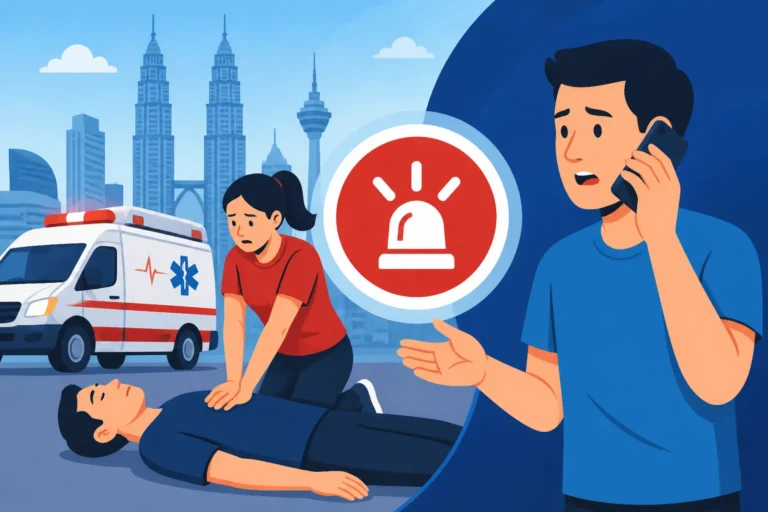
In Malaysia, calling 999 will usually send a government ambulance to take you to the nearest government hospital. If you want to be taken to a private hospital like Pantai or Gleneagles, you often have to call the hospital's direct ambulance line or use a private ambulance service. Most major private hospitals have their own fleet of branded ambulances.
Keep the direct emergency number of your preferred hospital saved in your phone. For example, Gleneagles and Pantai have dedicated lines that bypass the general 999 system. These ambulances are essentially mobile ICUs, but they will charge a fee based on the distance traveled. This fee is often covered by comprehensive plans like SafetyWing if the situation is a genuine emergency. For more on this, read Understanding Emergency Numbers (999) and Ambulance Services in Malaysia.
Medical Disclaimer
The information provided in this guide is for educational and informational purposes only and is based on the personal experiences of expats and the current healthcare landscape in Malaysia. This content is not intended to be a substitute for professional medical advice, diagnosis, or treatment. Always seek the advice of your physician or another qualified health provider with any questions you may have regarding a medical condition. Never disregard professional medical advice or delay in seeking it because of something you have read in this guide. The costs and procedures mentioned are subject to change by the respective hospital groups and insurance providers.